Louvers and Dampers
Every opening that moves air through a building envelope needs two things: protection from the weather and control over when air flows. Louvers handle the first job and dampers handle the second. Choose the wrong one, or size it poorly, and you get rain blowing into a mechanical room, cold drafts through an idle exhaust fan, or a fan that never reaches its rated airflow.
- Louvers are exterior wall units with angled, overlapping blades. They let air in or out while keeping rain, snow, debris, birds, and pests out. Most louvers have fixed blades and stay open all the time.
- Dampers control whether air flows and how much. Gravity backdraft dampers and shutters open with fan pressure and fall closed when the fan stops. Motorized dampers open and close on command from a fan, thermostat, or control system. Balancing dampers set the airflow in a duct run.
Many installations need both: a louver on the outside of the wall and a damper behind it that closes the opening when the system is off.
Louvers
A louver is a frame of angled, overlapping blades installed in an exterior wall opening. The blades let air pass while turning back rain, snow, and debris, and a bird or insect screen behind them keeps pests out. Louvers serve fresh air intakes, exhaust outlets, mechanical rooms, and equipment wall sleeves.
Every louver balances airflow against weather protection. A few features decide where it lands:
- Frame depth: Deeper frames (1, 2, or 4 inch) hold deeper blades that shed water better.
- Blade angle: Steeper blades, such as 45 degrees, block more rain and view than shallower 30 degree blades, at the cost of some airflow.
- Free area: The actual open space air passes through. More free area means more airflow and less pressure drop. To size a louver, divide the airflow (CFM) by your target velocity (FPM) to get the free area needed in square feet.
- Frame style: Flange frames overlap the opening and cover rough edges, which suits retrofits. Channel frames sit inside the opening for a flush look in new construction.
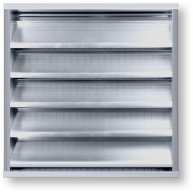
Stationary (Fixed Blade) Louvers
The most common louver: fixed, nondrainable blades in a 2 or 4 inch frame, open all the time.
Pros- Economical: Simple construction keeps the cost down.
- Good everyday weather protection: Handles normal rain at moderate airflow.
- Wide size range: Easy to size for most openings.
Cons
- Water carryover at higher airflow: Water can cascade from blade to blade and blow through as velocity rises.
- Always open: Needs a damper behind it if the opening must close.
Examples: Dayus DAL2 and DAL4 stationary louvers, S&P AFL aluminum and GFL galvaneal steel fixed louvers.
Drainable Louvers
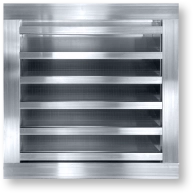
Drainable blades have a built-in gutter that catches water and channels it to the sides of the frame, where it drains away instead of passing through.
Pros- Best weather resistance: Handles wind-driven rain at higher airflow than standard blades.
- Ideal for outdoor air intakes: Keeps moisture out of filters and ductwork.
- Higher cost: More complex blade profiles cost more than stationary louvers.
- Deeper frame: Typically 4 inches deep, so they need more wall depth.
Examples: Dayus DALD4 drainable louver (AMCA certified), S&P DFL drainable fixed louver.
Thin Line Louvers
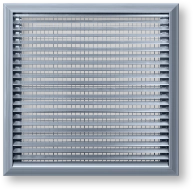
A 1 inch frame with closely spaced blades for a low profile, clean finish.
Pros- High free area: Very open design for maximum airflow in a small opening.
- Low profile and clean appearance: Hidden supports and a slim frame suit architectural applications.
- Equipment ready: Mounting options for PTAC and VTAC wall sleeves.
- Less weather protection: Shallow blades are best for low-velocity, protected locations.
- Not for high airflow intakes: Choose a deeper or drainable louver where rain is a concern.
Examples: Dayus DALTL-30 and DALTL-45 thin line louvers.
Combination Louver and Damper
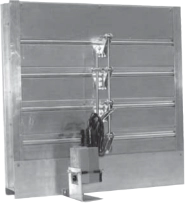
A weather louver in front and a shutoff damper behind it, built into one frame.
Pros- Closes the opening: Seals out air and weather when the system is off.
- One unit to install: No separate damper or extra framing.
- Can be motorized: Optional power open, spring return motor kits close automatically on loss of power.
- Higher cost: More expensive than a louver alone.
- Added resistance: The damper blades add some pressure drop.
Example: S&P ACL combination louver and damper.
Door Louvers
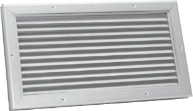
Door louvers are interior louvers that let air transfer through a door, so a closed room can still return air to the HVAC system or vent a closet or mechanical space.
Pros- Passive air transfer: No ductwork or power required.
- Privacy: Inverted V blades block the view through the door.
- Interior use only: Not designed for weather protection.
- Sound and light pass through: Not suited to spaces that need acoustic privacy.
Dampers
A damper is a set of blades, or a single plate, that opens and closes inside a duct, wall sleeve, or roof curb to control airflow. Some dampers simply stop air from flowing backward when a fan shuts off. Others open on command, or set exactly how much air flows. The main difference between them is what makes the blades move.
Gravity Dampers (Backdraft Dampers and Shutters)
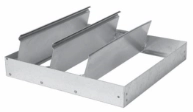
A gravity damper has no motor and no wiring. When an exhaust fan turns on, the air pressure pushes the blades open. When the fan stops, gravity lets the blades fall closed, blocking wind, cold air, rain, and pests from coming back in through the opening.
Pros- No power or wiring: Opens and closes on its own with the fan.
- Low cost and simple: Few moving parts and little maintenance.
- Wide range of materials: Galvanized, aluminum, stainless steel, and PVC blades suit everything from offices to barns and food plants.
- Exhaust only: Needs fan pressure to open, so it cannot be used for supply or fresh air intake.
- Orientation specific: Each model is built for horizontal or vertical mounting.
- Not an airtight seal: Blades can flutter or rattle in strong wind and allow some leakage.
Examples: S&P 411 and 611 horizontal backdraft dampers for roof curbs and ducts, and S&P 502, 556, EAS, 304SS stainless, and EASB/EASW PVC blade shutters for wall exhaust fans.
Spring Loaded Backdraft Dampers
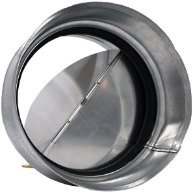
A spring loaded damper works like a gravity damper, but a light spring holds the blades closed until fan pressure overcomes it.
Pros- Positive closure: The spring closes the blades firmly every time.
- Any orientation: Works in horizontal, vertical, or angled duct runs.
- Resists wind: Less likely to flutter open from gusts.
- Added resistance: The fan has to overcome the spring, which slightly reduces airflow.
- Exhaust only: Like a gravity damper, it relies on fan pressure.
Motorized Dampers
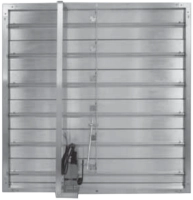
A motorized damper uses an electric actuator to drive the blades. Most are power open, spring close: when the motor receives power, usually from the fan or a control signal, it opens the blades, and when power is removed, a spring closes them.
Pros- Opens on command: Interlocks with a fan, thermostat, timer, or building automation system.
- Supply or exhaust: Works for fresh air intake and makeup air as well as exhaust.
- Tighter seal: Jamb and blade seals close more tightly than a gravity damper.
- Needs power and wiring: Adds electrical work to the installation.
- Higher cost: More expensive up front than gravity dampers.
- Actuator limits: Motors have their own temperature ratings and may eventually need service.
Balancing (Manual Volume) Dampers
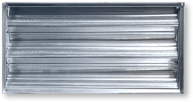
A balancing damper is set by hand to control how much air flows to an outlet or branch, rather than to open or close automatically.
Pros- Precise airflow: Fine tunes each room or branch so the system delivers what it was designed to.
- Inexpensive and power free: No motor or wiring.
- Easy access: Grille mounted versions adjust from the face of the grille.
- Manual only: Does not respond when the system turns on or off.
- Needs adjustment: Must be set during commissioning and rechecked if the system changes.
Examples: Dayus OBD opposed blade dampers that mount behind Dayus grilles, and Fantech Iris dampers with a built-in airflow measuring device.
Protecting and Controlling Every Opening
Louvers keep the weather out, and dampers decide when air moves. Choose louvers by how much weather protection the opening needs, and choose dampers by what should make them open and close. From made-to-order Dayus louvers and balancing dampers to S&P's full line of fixed louvers, shutters, and motorized dampers, with Fantech and Canarm rounding out the options, there is a solution for every opening.
Louvers and Dampers:
Dampers
Motorized as well as gravity dampers/shutters. Available in aluminum, steel, fibreglass and plastic.

1" Louvers
Exterior louvers. 1 inch frame depth. Flange and channel blade options.
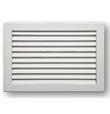
2" Louvers
Exterior louvers. 2 inch frame depth. Flange and channel blade options.
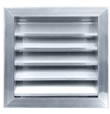
4" Louvers
Exterior louvers. 4 inch frame depth. Flange and channel blade options. Custom sizes as well as standard stock available.
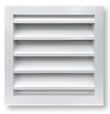

why buy from us?
We're engineers passionate about home ventilation and serious about customer service – so you can count on us for carefully-selected equipment and expert advice to ensure your project is a success from specification to installation.
Your call is answered by qualified people who will gladly discuss your project in detail, advise you professionally and never sell you inappropriate products.