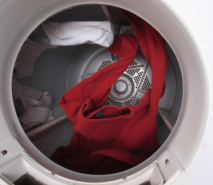
Dryers that don't work?
For many homeowners, a laundry routine that takes hours is treated as a minor nuisance, something to blame on an aging dryer or large loads of towels. If your dryer takes two or three cycles to dry a single load, or if the top of the appliance feels burning hot to the touch, the dryer itself might not be the problem at all.
The real culprit is often hiding behind the wall: restricted exhaust airflow.
Standard clothes dryers come equipped with modest internal blowers engineered to push moist air through no more than 25 equivalent feet of straight ductwork. Modern home layouts, however, frequently place laundry rooms in central locations, basements, or upper-floor closets. To vent air outdoors, ductwork must travel through long wall cavities, attics, or crawlspaces, often navigating tight 90-degree bends that severely slow air velocity.
The Warning Signs of Restricted Venting
When exhaust air cannot escape quickly, static pressure builds up inside the ductwork, triggering a chain reaction of costly and dangerous problems:
- Inordinately Long Dry Times: Moisture stays trapped in the drum, turning 45-minute loads into 2-hour ordeals that drive up monthly energy bills.
- Severe Lint Accumulation and Fire Risk: When airflow velocity drops below 1,200 feet per minute, heavy wet lint settles inside the piping rather than exiting outdoors. Dryer fires account for thousands of home fires each year, with lint buildup serving as the leading cause.
- Overheating and Appliance Failure: Trapped heat forces high-limit thermostats to trip repeatedly, causing premature motor burnouts and expensive service calls.
- Moisture Condensation and Mold: Warm, humid air lingering in unconditioned attic or crawlspace ducts condenses into liquid water, leading to leaking ceiling joints, duct corrosion, and hidden mold growth.
Solving these issues requires looking at the exhaust line as a complete mechanical system. Below, we break down the three essential product categories available on HVACQuick.com that restore proper velocity, safeguard your home, and keep your laundry running efficiently.
System Maintenance: Unchecked lint buildup increases internal static pressure, which significantly prolongs dry times and introduces a critical fire risk inside the wall cavity. Routine annual duct maintenance clears accumulated lint to improve drying performance and eliminate ignition hazards along the exhaust path.
Inline Dryer Booster Fans
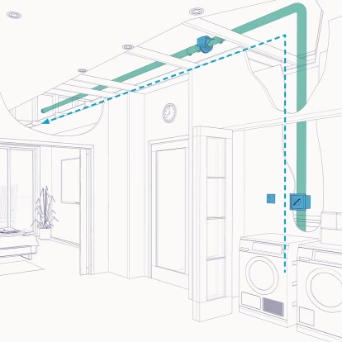
When a dryer exhaust run exceeds 25 equivalent feet, inline booster fans actively pull humid air through long ductwork to maintain the required minimum airflow velocity of 1,200 FPM.
Key Models
- Fantech DBF Series (DBF 4XL / DBF 4XLT / DEDPV-705): Built with self-cleaning, backward-curved centrifugal impellers that prevent lint accumulation. The DBF 4XL uses an integrated pressure switch, while the DEDPV-705 model meets strict IRC codes for dryer exhaust duct power ventilators.
- Vortex DBF-DEDPV (with Lint Trap): A complete, code-compliant kit featuring an integrated pressure switch, an inline secondary lint trap, and a remote wall-mounted status panel with 50 feet of cable.
- S&P Dryer Booster Fans (S&P PV-100X / DB10): Engineered with high-efficiency mixed-flow or centrifugal impellers designed to minimize dry times, lower electric bills, and withstand high static pressure.
Technical Pros and Cons
Pros:
- Protects Dryer Motor: Relieves backpressure, preventing thermal fuse trips and premature motor wear.
- Prevents Condensation: Keeps exhaust moving fast so moisture does not collect in cold attic or crawlspace ducting.
- Automatic Operation: Pressure and current switches turn the fan on and off automatically with the dryer.
Cons:
- Higher Upfront Cost: Certified DEDPV kits are significantly more expensive than standard inline fans.
- Maintenance Requirement: Fans must be paired with an accessible upstream lint trap to protect the impeller.
- Wiring Required: Requires dedicated 120V power and low-voltage routing for remote status panels.
Safety Note: Verify compatibility prior to specification. Select dryer booster fans are strictly designed for electric dryers and are not rated for gas dryer applications.
Dryer Exhaust Caps and Terminations
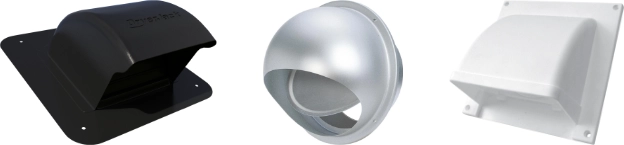
Exterior termination caps provide a low-resistance discharge point while preventing outdoor weather, backdrafts, and pests from entering the duct.
Key Models
- Seiho SB and SFB Series: Anodized aluminum vent caps featuring built-in backdraft flappers to prevent cold drafts. SFB models include a flanged mounting collar for easier installation.
- InOvate DryerJack Roof Caps (DJK477 / DJK486): Heavy-gauge galvalume steel roof caps designed with a curved, low-profile damper flap that opens wide under low airflow to minimize backpressure.
- Primex DV4 Series: A low-profile, single-piece plastic exterior wall vent designed specifically for 4-inch dryer ducting, providing a simple, weather-tight sidewall seal.
Technical Pros and Cons
Pros:
- Screenless Airflow: Purpose-built caps omit fine bug screens that trap dangerous lint debris and cause clogs.
- Draft Protection: Backdraft flappers and dampers prevent cold outside air and wind from entering the home.
- Corrosion Resistance: Anodized aluminum (Seiho) and galvalume steel (DryerJack) withstand harsh outdoor exposure.
Cons:
- Roof Clearance Access: Roof-mounted caps require ladder access for periodic lint checks.
- Material Differences: Lightweight plastic caps (like Primex) are budget-friendly but less resilient than heavy-gauge steel or aluminum under severe weather and UV exposure.
- Installation Effort: Roof caps require proper flashing under shingles to prevent water leaks.
Dryer Vent Boxes and Flexible Couplings
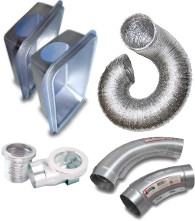
The transition area behind the laundry appliance is the most frequent chokepoint. Recessed wall boxes and heavy-duty transition ducting prevent kinking and crushing.
Key Models
- InOvate Dryerbox (Model 425 / 350): Recessed metal wall enclosures (available for 2x4 and 2x6 framing) that allow the flex hose to bend without getting crushed behind the dryer.
- MagVent MV-90: A self-aligning magnetic dryer coupling designed for 90-degree vent paths. It uses strong neodymium magnets to connect the dryer flush to the wall duct.
- InOvate DryerFlex: A flexible, flame-resistant metallic transition hose that combines the flexibility of foil hose with the smooth airflow and fire safety of semi-rigid aluminum.
Technical Pros and Cons
Pros:
- Saves Up to 6 Inches of Space: Recessed boxes and magnetic couplings allow appliances to sit flush against the wall.
- Fire Safety: All-metal transition hoses (DryerFlex) resist flame spread better than flimsy foil or plastic transition kits.
- Easy Maintenance: Magnetic couplings snap on and off effortlessly, making pulling the dryer out for cleaning simple.
Cons:
- Wall Cutting and Retrofit: Recessed boxes require cutting drywall if installed into existing construction.
- Precision Placement: Magnetic connectors (MagVent) require careful measuring during installation to align properly.
- Hardware Cost: Adds upfront material expense compared to standard cheap foil hoses.
Optimize Your Dryer Ventilation
From eliminating rear wall chokepoints with recessed boxes and magnetic couplings to overcoming long duct friction with inline dryer booster fans and low-resistance termination caps, every component plays a specific role in optimizing your drying capabilities.
Dryer Boosting Categories:
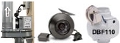
Dryer Booster Fans
Dryer Booster fans help clothes dryers push air through long or convoluted ducts. Boosting is generally needed in order to maintain a minimum airflow of 100cfm as duct length increases and bends are introduced in the duct line.
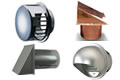
Dryer Exhaust Caps
Exhaust caps specifically tailored for dryer exhaust or other lint/particle laden air streams.
Dryer Vent Boxes & Couplings
Dryer Vent Boxes and Couplings for safer and more efficient drying. Using a recessed dryer vent box protects your walls from the heat of the dryer, allows for easier duct attachment, and prevents condensation from building up and creating a spot for mold or mildew. Couplings maintain dryer path and efficiency.


why buy from us?
We're engineers passionate about home ventilation and serious about customer service – so you can count on us for carefully-selected equipment and expert advice to ensure your project is a success from specification to installation.
Your call is answered by qualified people who will gladly discuss your project in detail, advise you professionally and never sell you inappropriate products.